Buying a forklift is one of the bigger equipment decisions a business will make. And like most big decisions, it comes with a lot of assumptions, some right, some very wrong. After years of selling and servicing forklifts at Mister Mechanic, we’ve seen both sides of this conversation play out hundreds of times. Here’s the honest version nobody else is going to give you.
Forklifts Are Not Indestructible
Let’s start here because this is the most common and most costly assumption we see. People buy a forklift, sometimes brand new, and treat it like it can handle anything, anywhere, under any conditions.
We once sold a new forklift to a customer who, during the entire purchasing process, kept telling us “don’t worry, I know what I’m doing.” We asked the right questions, we always do, but he wasn’t interested. Turns out he had a gravel surface at his facility. What he didn’t know is that the forklift he bought was not designed to operate on gravel. The truck got stuck. He called us to get him out.
The machine doesn’t care how confident you are. It has specs, limitations, and an environment it was built for. Buying the wrong truck, new or used, is an expensive mistake that starts before you even sign anything.
Before you buy anything, talk to someone who will actually ask you the uncomfortable questions. Where will it operate? What surface? How many hours a day? What are you lifting and how heavy? The right answers lead to the right truck.
What to Look at When Buying Used
A used forklift can be an excellent investment, but only if you know what you’re looking at. Here’s what we check before we put our name on anything used.
Service history first. Just like a car, a forklift needs regular maintenance, typically every 250 to 300 hours. No service records is a red flag. It doesn’t mean the machine is junk, but it means you don’t know what you’re getting into.
The cylinders. The tilt cylinder and mast cylinder are the most expensive components to repair on a forklift. We always inspect these first. Any signs of leaking, scoring, or wear gets factored into the price or it’s a deal breaker.
Look under the forklift. This one is simple but most people skip it. Get underneath and look for any signs of fluid leaks, oil pooling, or wet spots around the seals and hoses. If it’s leaking before you buy it, it’s your problem the moment you sign.
Tires. Worn tires affect stability, load handling, and safety. They’re not cheap to replace, so factor that into your budget if they’re showing wear.
Hydraulic hoses. Cracked, worn, or leaking hoses are a maintenance cost waiting to happen. Easy to spot, easy to negotiate on.
Body damage. Most used forklifts have some cosmetic damage, dents, scrapes, paint wear. That’s normal in an industrial environment and in most cases doesn’t affect performance. What matters is whether the damage is structural.
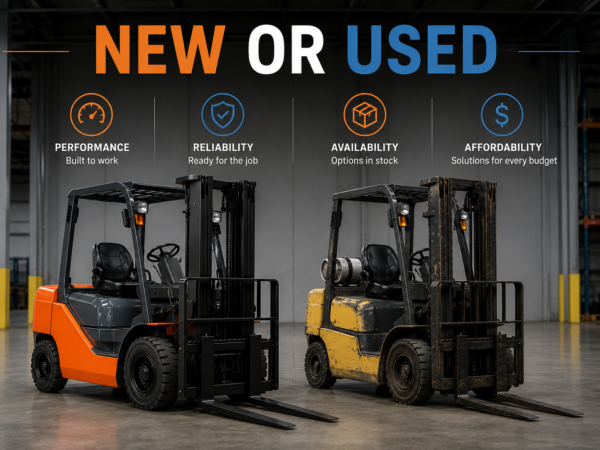
Used forklifts typically cost 30% to 50% less than new units, and in the right situation, that savings is real and significant, but only if the machine has been properly looked after.
When Does New Actually Make Sense?
The honest answer is it depends on the customer and how they operate.
A new forklift will always outlast a used one in the long run and that’s reflected in the price. New standard forklifts in 2026 range from $20,000 to over $85,000 depending on type and capacity, while a solid used unit can be had for significantly less.
But here’s where fuel type and utilization change everything.
For electric forklifts, if a customer is heavily dependent on their forklift and running it most of the day, we lean toward recommending new or at minimum a new battery. A used electric forklift with a tired battery is going to let you down mid-shift. Electric models cost more upfront but can save $10,000 to $15,000 over a five year ownership period through lower fuel and maintenance costs, but only if the battery is in good shape.
For propane and diesel, the calculus is different. These machines are more forgiving hours, easier to service, and parts are widely available. A well maintained used propane forklift with good service history can be a workhorse for years.
A used forklift tends to be the most cost-effective solution for light to medium use, under four hours a day, allowing you to avoid the steep initial depreciation of new equipment. If you’re running it all day every day, new starts to make a lot more sense.
The Hidden Cost Everyone Forgets About
This is the one that surprises people most after the purchase: maintenance.
A lot of used forklift buyers bring the machine home and never think about it again until something breaks. That’s the wrong approach. Forklifts need to be serviced every 250 hours and require an annual safety inspection every year. In Ontario, that safety certificate isn’t optional, it’s the law.
If a forklift hasn’t been properly maintained throughout the year, getting that safety certificate issued is going to cost money. Work needs to be done to bring it up to standard.
A customer working in a dusty environment, a lumber yard, a construction site, a manufacturing floor, needs to be blowing out their forklift almost daily. Fine dust particles get into the cylinders and destroy the seals. Destroyed seals mean leaks. Leaking cylinders mean the mast can drop unexpectedly. That is not a repair bill, that is a safety emergency. It will not pass an annual inspection and it puts everyone working on or around that machine at serious risk.
The cost of ignoring maintenance on a used forklift almost always exceeds what the maintenance would have cost in the first place.
So, New or Used?
Here’s our honest take after doing this for years.
Buy used if your utilization is moderate, you have a good service provider (AKA Mister Mechanic 😊), and the machine has a clean history. You’ll save real money upfront and get solid performance if you take care of it.
Buy new if you’re running the machine hard all day, you’re in a demanding environment, or you simply don’t want to think about it. The warranty, reliability, and peace of mind are worth the premium for the right operation.
Either way, ask the right questions before you buy, maintain it after, and work with someone who’s going to tell you what you need to hear and not just what you want to hear.
That’s what we’re here for.