May 19, 2026, Posted in: Forklifts
Forklift Overloading Is Not an Option
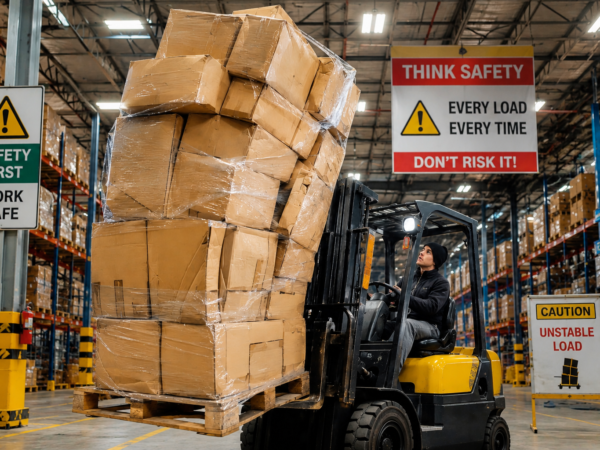
Overloading a forklift might seem like a minor shortcut in the moment — but the consequences can be severe. From serious workplace injuries to costly equipment damage, exceeding your forklift’s rated capacity is one of the most preventable and dangerous mistakes in any warehouse or industrial operation.
The Capacity Plate Is the Law — Not a Suggestion
Every forklift is required by law to have a capacity plate mounted on the vehicle. This plate tells the operator the maximum load the machine is designed to safely lift. But here’s what many operators don’t realize — that number changes the moment you add attachments.
Side shifters, fork positioners, and bale clamps can derate your forklift’s actual lifting capacity by as much as 15%. That means a machine rated at 5,000 lbs will safely lift less than that with an attachment installed. Ignoring this is not just a safety risk — it’s a compliance issue.
The Problem With Unknown Load Weights
One of the biggest challenges in busy warehouse environments is that loads aren’t always clearly or accurately marked. Consider lumber yards, manufacturing plants, or distribution centers handling thousands of SKUs, bundled loads that range from 5,000 to 20,000 lbs are rarely weighed on traditional floor scales. Shipping data is often a manual calculation, and individual piece weights bundled together leave room for significant error.
When you combine an unknown load weight with an attachment that reduces capacity, you have a recipe for disaster.
The risks of overloading include:
– Tip-overs and loss of stability: Overloaded forklifts are far more susceptible to tipping, especially when turning or navigating ramps.
– Mast and hydraulic damage: Exceeding capacity puts extreme stress on the mast, cylinders, and hydraulic system — leading to costly repairs and downtime.
– Brake and steering failure: An overloaded machine takes longer to stop and is harder to control, especially on wet or uneven surfaces.
– Operator injury or fatality: Tip-overs are one of the leading causes of forklift-related deaths in North America.
Know Your Machine, Know Your Load
The right approach is simple but requires discipline across your entire team:
– Always check the capacity plate before lifting — and factor in any attachments that may reduce the rated capacity.
– Never assume a load weight, verify it. If the load isn’t clearly marked, find out before you lift it.
– Train your operators to recognize overload situations and feel empowered to stop work when something doesn’t feel right.
– Use the right truck for the right load. Not every forklift on your floor is rated for every load in your facility.
The Right Tools Make a Difference
Technology now exists to take the guesswork out of load weight entirely. Onboard weighing systems can display the load weight in real time, alert operators when they’re approaching or exceeding capacity, and reset only once the load is safely back on the ground. For high-volume operations handling varied load weights, this kind of safeguard is a smart investment in both safety and efficiency.
Final Thoughts from Mister Mechanic
At Mister Mechanic, we work with businesses across Ontario every day, and overloading is one of the most common and avoidable causes of forklift damage we see in the shop. Protecting your operators, your equipment, and your operation starts with respecting the limits your machine was built for.
If you have questions about your forklift’s capacity, need a safety inspection, or want to talk through your fleet’s needs, we’re here to help.